
Ever wondered how a tree that is hollow on the inside can be alive, or have not fallen when 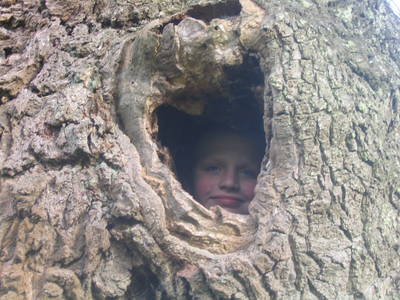 the wood is hollow in the middle? Internal decay is a common phenomenon in trees. I wouldn’t call it good, but it is normal (i.e. very common). These cavities are caused by mother nature’s decay fungi. Their job in the grand scheme of things is decompose woody materials back into the soil.
The decay process usually gets started from some large wound. Could have been from a lightening strike, broken limb or even a damaged root underground. Any large wound usually leads to decay. Wounds larger than about 3-4″ diameter (can vary depending on tree species and health) take the tree so long to callous over and close up the wound that rotting fungi get established and start breaking down the inner column of wood in the tree.
It is a good idea to avoid making large wounds to trees. If you can achieve your goals of pruning by removing multiple small limbs instead of one big limb, that is ideal. If you have to trench or cut roots near a tree, stay as far from the trunk as possible. Or, use an airspade to dig without cutting roots.
Many trees, such as live oaks do a good job of compartmentalizing the decay. This means that the fungi only 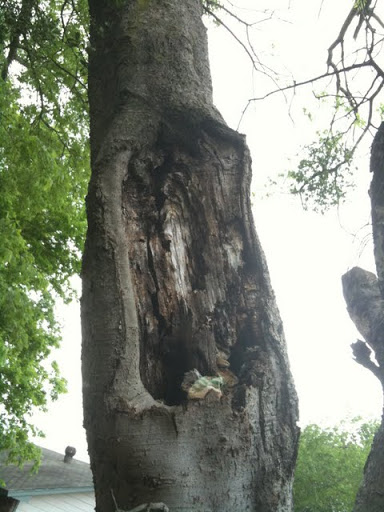 rot away the dead wood in the center of the tree and the newer growth rings are protected. Therefore, internal decay is usually more of a structural integrity issue and less of a health and vigor issue for trees. Some trees do a very poor job of compartmentalizing decay and should be evaluated carefully. Hackberry and Ash are two good examples of trees that do a poor job of compartmentalizing decay.
Compartmentalizing decay is one way that trees deal with decay. There is another factor that affects a trees ability to tolerate wood rotting away. I like to explain this by comparing to a steel fence post. A steel fence post is hollow in the center, but its shape gives it strength. The same goes for a tree. The tree can tolerate loss of wood in the middle so long as the tree puts on new growth rings on the outside. Each new set of rings adds to the tree’s strength.
“Rams-horns” also help trees deal with massive trunk wounds. If there is a very large wound on the side of the tree trunk, this type of wood development will usually occur. 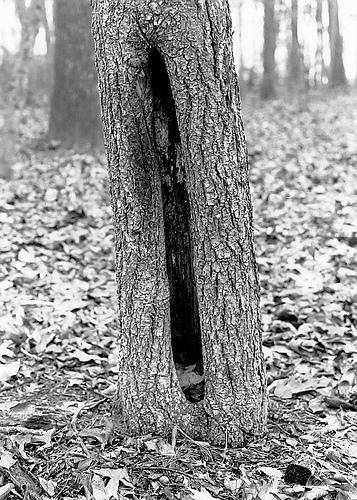 A “rams-horn” is when the new callous tissue growing on the edge of the wound culs inward to create a columnar growth rather than growing flat across the wound. Growing flat across the wound would heal the wound faster, but rams horns provide better structural improvement. By growing these two columnar growths on each side of the wound the tree has create two smaller “fence posts” on each side of the wound.
Decay is a tricky subject; even for the most experienced and skilled arborists. Tree species, tree health, weather conditions and the location of the tree all play a role in quantifying the risk factor of a tree with rot. Most importantly, you should consider potential targets. If the tree is in a field you can live with a high percentage chance of it falling over. If it is growing over your kids play area, you can’t tolerate much risk at all.